2022 Reducing Scope 3 Emissions – Webinar Series : Global Compact Network UK
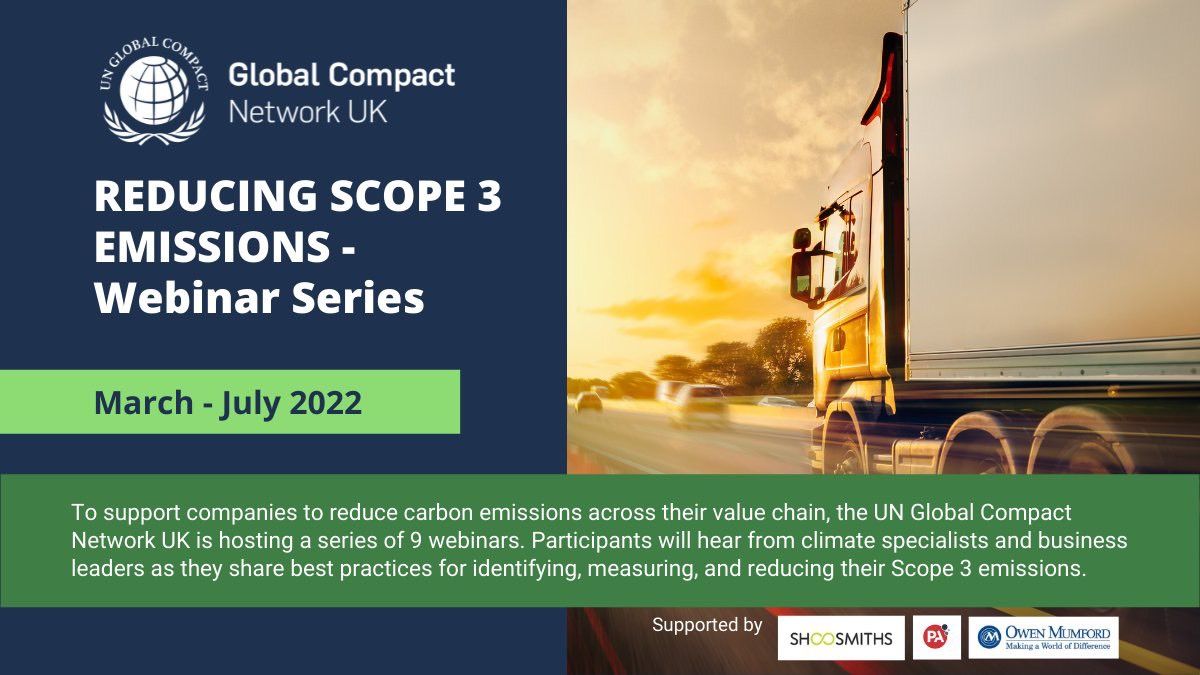
March – July 2022
To support companies to reduce carbon emissions across their value chain, the UN Global Compact Network UK hosted a series of topical webinars exploring how companies can tackle Scope 3 emissions categories as defined by the GHG Protocol. Participants heard from climate specialists and business leaders as they shared best practices for identifying, measuring, and reducing their Scope 3 emissions.
The Greenhouse Gas Protocol Corporate Standard classifies a company’s GHG emissions into three ‘scopes’:
- Scope 1 emissions: direct emissions from owned or controlled sources.
- Scope 2 emissions: indirect emissions from the generation of purchased energy.
- Scope 3 emissions: all indirect emissions (not included in Scope 2) that occur in the value chain of the reporting company, including both upstream and downstream emissions.
As Scope 3 emissions usually account for more than 70 percent of a business’ carbon footprint, it is crucial that companies tackle Scope 3 emissions to meet the aims of the Paris Agreement and limit global warming to 1.5°C.
There are numerous benefits associated with measuring and reducing Scope 3 emissions. By measuring Scope 3 emissions, organisations can:
- assess where the emission hotspots are in their value chain;
- identify resource and energy risks in their supply chain;
- identify which suppliers are leaders and which are laggards in terms of their sustainability performance;
- identify energy efficiency and cost reduction opportunities in their value chain;
- engage suppliers and assist them to implement sustainability initiatives;
- improve the energy efficiency of their products; and
- positively engage with employees to reduce emissions from business travel and employee commuting.
While companies are now recognising the importance of addressing their Scope 3 emissions, action in this area must be scaled up to reach true net zero by 2050.
Watch recording here:
- Employee Homeworking and Commuting
- Business Travel
- Investments
- Transportation and Distribution
- Waste-related Emissions
- Leased Assets
- Sold Products
- Purchased Goods & Services and Capital Goods
- Fuel and Energy-Related Activities
More Information: https://www.unglobalcompact.org.uk/scope-3-emissions
To support companies to reduce carbon emissions across their value chain, the UN Global Compact Network UK hosted a series of topical webinars exploring how companies can tackle Scope 3 emissions categories as defined by the GHG Protocol. Participants heard from climate specialists and business leaders as they shared best practices for identifying, measuring, and reducing their Scope 3 emissions. In this first session of the series, participants learned about Category 7 – employee commuting and homeworking.
Guest speakers included:
– Emma Watson, Net Zero Senior Manager, CDP & SBTi
– Alexis Munro, Climate & Environment Manager, NatWest
– Matteo Deidda, Senior Sustainability Manager, Lloyds Banking Group
To support companies to reduce carbon emissions across their value chain, the UN Global Compact Network UK hosted a series of topical and interactive webinars exploring how companies can tackle Scope 3 emissions categories as defined by the GHG Protocol. Participants heard from climate specialists and business leaders as they shared best practices for identifying, measuring, and reducing their Scope 3 emissions. This session focused on Category 6 – Business Travel.
Guest speakers included:
– Natasha Allard, Global Environment Strategy Lead, Dentsu International
– Olwen Smith, UK & Worldwide Regional Lead – Commit to Action Programme, CDP & SBTi
– Peter Duff, Chairperson, Shoosmiths
To support companies to reduce carbon emissions across their value chain, the UN Global Compact Network UK hosted a series of topical and interactive webinars exploring how companies can tackle Scope 3 emissions categories as defined by the GHG Protocol. Participants heard from climate specialists and business leaders as they shared best practices for identifying, measuring, and reducing their Scope 3 emissions. This session focused on Category 15 – Investments.
Guest speakers included:
– Nate Aden, Finance Sector Lead, Science Based Targets initiative
– Stephanie Chang, Head of ESG Integration, Schroders
– Tony Burdon, CEO, Make My Money Matter
To support companies to reduce carbon emissions across their value chain, the UN Global Compact Network UK hosted a series of topical and interactive webinars exploring how companies can tackle Scope 3 emissions categories as defined by the GHG Protocol. Participants heard from climate specialists and business leaders as they shared best practices for identifying, measuring, and reducing their Scope 3 emissions. This session focused on Categories 4 and 9 – Transportation and Distribution.
Guest speakers included:
– Andrew Davenport, Head of Distribution Zone Europe, Nestlé
– Olwen Smith, Global Lead – Commit to Action Programme, CDP & SBTi
– Oliver Hurrey, Founder and Chair, Scope 3 Peer Group
To support companies to reduce carbon emissions across their value chain, the UN Global Compact Network UK hosted a series of topical and interactive webinars exploring how companies can tackle Scope 3 emissions categories as defined by the GHG Protocol. Participants heard from climate specialists and business leaders as they shared best practices for identifying, measuring, and reducing their Scope 3 emissions. This session focused on Category 5 – Waste-related Emissions.
Guest speakers included:
– Emma Watson, Net Zero Senior Manager, CDP & the Science Based Targets initiative
– Dr Warren Bowden, Head of Sustainability & Innovation, Scottish Leather Group
– Kim McCann, Global Head of Sustainability – Consumer & Manufacturing, PA Consulting
To support companies to reduce carbon emissions across their value chain, the UN Global Compact Network UK hosted a series of topical and interactive webinars exploring how companies can tackle Scope 3 emissions categories as defined by the GHG Protocol. Participants heard from climate specialists and business leaders as they shared best practices for identifying, measuring, and reducing their Scope 3 emissions. This session focused on Categories 8 and 13 – Leased Assets.
Guest speakers included:
– Fernanda Amemiya, Sustainability Director, Landsec
– Karl Desai, Senior Advisor – Advancing Net Zero, UK Green Building Council
– Olwen Smith, UK & Worldwide Regional Lead – Commit to Action Programme, CDP & SBTi
Guest speakers included:
– Emma Darroch, Responsible Business Manager, Sky
– Emma Watson, Net Zero Senior Manager, CDP & the Science Based Targets initiative
– Mark Lancelott, Consulting Director, PA Consulting
To support companies to reduce carbon emissions across their value chain, the UN Global Compact Network UK hosted a series of topical and interactive webinars exploring how companies can tackle Scope 3 emissions categories as defined by the GHG Protocol. Participants heard from climate specialists and business leaders as they shared best practices for identifying, measuring, and reducing their Scope 3 emissions. This session focused on Categories 1 and 2 – Purchased Goods & Services and Capital Goods.
Guest speakers included:
– Amelie Tan, UK & Worldwide Regional Lead, Transition Accelerator, CDP & Member of SBTi’s Corporate Engagement Team
– Isobel Filipova, Design Engineer (Sustainable Product Development), Owen Mumford
– Rodrigo Barrios, Climate Change Manager – Supply Chain, Tesco
– Sonya Bhonsle, Global Head of Value Chains & Regional Director Corporations, CDP
To support companies to reduce carbon emissions across their value chain, the UN Global Compact Network UK hosted a series of topical and interactive webinars exploring how companies can tackle Scope 3 emissions categories as defined by the GHG Protocol. Participants heard from climate specialists and business leaders as they shared best practices for identifying, measuring, and reducing their Scope 3 emissions. This final session in the series focused on Category 3 – Fuel- and Energy-Related Activities Not Included in Scope 1 or Scope 2.
Guest speakers included:
– Julia Creasey, Group Sustainability Director, Croda
– Olwen Smith, Global Lead, Transition Accelerator, CDP & Member of SBTi’s Corporate Engagement Team
– Steven Thompson, Environmental Sustainability Manager, National Grid
More Information: https://www.unglobalcompact.org.uk/scope-3-emissions
We thank Shoosmiths, Owen Mumford, and PA Consulting for sponsoring this series.